

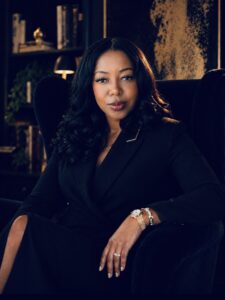
From becoming a mother at 16 to building a career in business, technology, and organizational change, Cameal Harris is proof that where you start does not have to decide where you finish.
There are people who talk about change, and then there are people who have lived it.
Cameal Harris belongs to the second group.
Today, Harris works at the meeting point of business, technology, psychology, and leadership. She helps organizations understand something that can easily get lost in the race for growth: a company cannot truly change unless its people are part of that change.
Her career includes work in large organizational transformations and experience with companies such as PepsiCo, Unilever, and Vitamix. She is also the founder of boutique consulting firm Change Activate and the creator of her own approach to change management.
But the polished résumé tells only part of the story.
Long before the meetings, consulting projects, books, and executive conversations, Harris was a teenager in Jamaica facing a future that looked very different.
Harris shared with ATELIER that she became a mother to twins at just 16 years old. She also left high school in Jamaica after becoming pregnant.
There were moments when continuing forward felt difficult.
Still, Harris believed there was something more inside her.
“I had the feeling that there was something greater in me,” she recalled during her ATELIER interview.
That belief became an important part of how Harris changed her life. Instead of waiting until she reached success to see herself differently, she began thinking about the woman she wanted to become.
She asked herself how that woman would dress. How would she care for her health? What kinds of conversations would she have? Who would she spend time with?
Harris says she even saw herself as a millionaire before she became one. She began changing her habits and the way she showed up in the world to match the future she believed was possible.
Her story was not polished, and Harris does not pretend that it was.
That may be exactly what makes it powerful.
Before becoming known for organizational transformation, Harris had experience as a teacher and in behavioral health. She later realized those skills could transfer into change management.
That discovery helped shape her career.
During the COVID-19 era, Harris began helping people who wanted to enter the technology industry. Many believed tech careers were limited to jobs such as coding or project management. Harris saw something different. She understood that people often already had useful skills from other careers—they simply needed to learn how those skills could fit into a new industry.
She began mentoring and coaching people for free.
That experience also showed Harris a problem. People could earn certifications in change management, yet still struggle when they entered real workplaces. The lessons on paper did not always match what happened inside an actual company.
So Harris developed her own methodology.
Over time, her work moved beyond helping companies simply roll out new systems. Harris began paying closer attention to how employees actually felt during change. She saw companies send emails, offer training, and check boxes showing that a new system had been introduced. But that did not always mean employees truly accepted it.
Something was missing: trust and psychological safety.
For Harris, that changed everything.
“People Are the Greatest ROI”
Business leaders often talk about return on investment, or ROI. Harris believes companies should look at their employees as one of their most important investments.
“I believe that people are the greatest ROI within an organization,” Harris said.
Her point is simple: when employees feel supported, heard, and safe, companies have a better chance of succeeding.
Harris describes creating psychologically safe workplaces as more than a business mission. She calls it her “ministry.” Her work now focuses on helping leaders create organizations where trust becomes part of the culture rather than another line in a company handbook.
She has also seen what happens when leaders do not listen.
During one major technology project, Harris encountered a longtime employee who had worked for an automobile company for more than 30 years. The company was replacing an older system with new technology. Yet the employee had not truly been included in the process.
She had years of knowledge stored in the way she worked, including a system she had built herself. When consultants arrived to introduce something new, she began thinking it might simply be time to retire.
For Harris, that moment showed the danger of ignoring people during innovation. The company could have lost decades of knowledge because one employee did not feel included.
Harris chose to listen to her.
The situation improved.
That experience reinforced a lesson that continues to guide Harris today: technology may change how people work, but people still determine whether that technology succeeds.
That belief has become even more important during the rise of artificial intelligence.
As companies rush to adopt AI, Harris warns leaders not to forget the people using the technology.
Her approach begins with involvement. Employees should be invited into the process. They should test new tools, ask questions, share concerns, and give feedback. More importantly, leaders should actually respond to that feedback.
“Without the people, your technology is useless,” Harris said. “AI is a tool.”
Harris believes AI cannot replace the human connection at the center of business. Companies still have customers, employees, vendors, and communities. Technology can support those relationships, but it cannot fully replace them.
It is a message that feels especially important now.
The future may be powered by technology, but Harris believes it still has to be led by people.
Harris also refuses to let her career become her entire identity.
She is a mother of five in a blended family. Her children have watched her work, study, build, fail, recover, and keep moving forward.
Instead of trying to appear perfect, Harris chose to be honest with them about her mistakes. She encouraged her children to discover their own interests rather than simply follow the path she wanted for them.
Her parenting philosophy can be summed up in three ideas: lead by example, keep it real, and support each child as an individual.
Family also helps Harris separate the executive from the person.
“When I’m home, I take off that hat of CEO and tech founder,” she explained.
At home, she focuses on being a mother and nurturer. She also tries to live with intention. Whether she is working, traveling, spending time with family, or sitting for an interview, Harris likes to decide what she wants to receive from the experience before it begins.
That includes making time for herself.
Harris is open about burnout and the need for rest. She recently spent 25 days in Costa Rica taking time to “pour into” herself. For someone whose career centers on helping people manage change, she understands that she must also protect her own mental and emotional energy.
And because this is ATELIER, there was one more side of Harris worth exploring: style.
Give her a colorful suit, great hair, and a reason to walk into a room with confidence, and Harris is ready.
“My clothes look good, you can’t tell me nothing,” she joked.
For Harris, fashion is connected to how she feels. She says putting on her executive look can change the way she carries herself. She is especially interested in discovering Black and Nigerian designers and loves clothing filled with color.
But her connection to beauty goes much deeper.
Harris revealed that there was a time when she and her family lost everything and lived in a shelter. During that period, something as small as putting on makeup helped her get up in the morning.
That experience stayed with her.
Today, Harris wants to create beauty kits for women living in shelters, especially mothers. She believes the simple act of doing your hair, applying makeup, or taking time to care for yourself can help someone begin to see herself differently again.
For Harris, style is not simply about looking good.
It can be a reminder that you are still here.
After a conversation covering business, motherhood, technology, fashion, mental wellness, and her own journey, Harris’s final lesson for executives was surprisingly simple:
“Invest in your people.”
Companies invest millions in technology, buildings, systems, and new ideas. Harris wants leaders to give that same attention to the human beings responsible for making those investments work.
Her advice goes beyond budgets.
Leave the boardroom sometimes. Walk the factory floor. Have lunch with the receptionist. Talk to employees who may never enter the executive suite.
“Just be a human,” Harris said.
It may be one of the simplest leadership lessons an executive can receive.
Cameal Harris’s own life makes that message difficult to ignore.
She has been the teenage mother wondering what came next. She has been the woman rebuilding. She has been the employee, student, teacher, mentor, mother, entrepreneur, and leader. Her journey has taught her that people can change when they are given the room, tools, support, and belief to do it.
Now she is asking companies to believe in people the same way she once learned to believe in herself.
And perhaps that is the real lesson behind her work: before transformation becomes a strategy, a system, or a technology, it begins with a person.

