
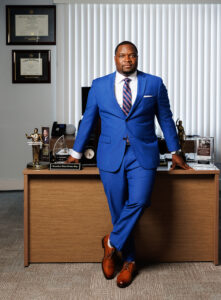
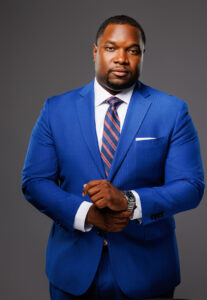


The young attorney building a legal career across Alabama and Georgia believes the power of law reaches far beyond the courtroom. For Price-Crum, justice is about access, representation, community and creating change that can outlive a single case.
There is a particular kind of authority that does not need to announce itself. It is measured in preparation, discipline and the willingness to stand firm when the stakes are high. Attorney Brandon Price-Crum appears to be building his career around that kind of authority. Practicing across Alabama and Georgia, Price-Crum represents a generation of attorneys who understand that the courtroom is not separate from culture, community or everyday life. His philosophy begins with a straightforward belief: justice should be accessible to everyone. In his view, wealth, race or social position should not determine whether someone receives a fair opportunity to bring a claim or defend themselves.
That understanding of justice gives Price-Crum’s work a larger purpose. He speaks about legal cases not simply as disputes between opposing parties, but as opportunities to confront policies and practices that may affect entire communities. He is particularly interested in challenging matters that can influence how companies operate, how institutions treat people and how future generations experience the law. It is an ambitious approach for a young attorney, but Price-Crum does not separate professional responsibility from social responsibility. He believes attorneys possess knowledge that can help remedy wrongs, and that knowledge carries an obligation to use it thoughtfully.
His perspective did not begin in law school. Price-Crum describes being inspired by civil rights leaders and the extraordinary courage required of people who challenged injustice even when doing so placed their safety, freedom and families at risk. Their example helped him recognize law as more than a profession. It could become a vehicle for building a better society. While graduating from Alabama State and preparing for the LSAT, another idea strengthened that conviction: nearly every industry—from business and real estate to journalism—is governed in some way by law. Understanding that structure meant understanding one of the forces shaping American life.
Yet some of Price-Crum’s most important lessons came much closer to home. His mother worked on the front line for Ford Motor Company for more than 13 years, while his father was an entrepreneur and community advocate. From his parents, he says, came lessons about hard work, education, perseverance, mentorship and caring about other people. Those values remain visible in the way he approaches leadership today. With four offices operating across two states, his responsibilities now extend beyond his own career. Employees and families depend on decisions made within the practice, turning leadership from an impressive title into a daily obligation.
Price-Crum is now a partner at Sears Injury Law Group, and his path there reveals perhaps one of the clearest statements about his definition of success. When considering his professional options, he says he turned down opportunities offering more money and positions that could have been viewed as more prestigious. What captured his attention instead was the opportunity to help build a law firm whose mission could matter to the community. It was a decision that placed purpose above immediate recognition. In an era when professional success is often presented through salary figures, titles and social status, Price-Crum offers another equation: sometimes the right room is more valuable than the biggest check.
That decision also speaks to representation. Price-Crum recalls being inspired during his interview by seeing two respected Black male attorneys who could speak honestly about the experience of practicing law, particularly in Alabama. Today, the firm has expanded into Georgia, and Price-Crum has become part of the leadership helping shape its future. He describes a minority-owned practice that values professionals with different backgrounds and life experiences because those differences can strengthen the firm’s ability to understand and represent its clients. He also sees himself within a longer tradition of Black attorneys who used their legal knowledge and public voices to address social issues.
There is also an entrepreneur beneath the attorney. Price-Crum recognizes a distinction that law school does not always fully prepare attorneys to navigate: the practice of law and the business of law are not the same thing. Lawyers learn cases, rules, arguments and procedure, but operating a firm requires another education entirely. Leadership, marketing, infrastructure and scalability become essential. For Price-Crum, building a sustainable practice means creating systems capable of supporting growth without losing the values behind the organization. With four offices, including three opened within a three-year period, that conversation about scale is no longer theoretical.
The modern legal profession also exists in a world of social media, personal brands and instant public commentary, something Price-Crum approaches carefully. He recognizes digital media as a powerful educational and communication tool, capable of giving attorneys access to audiences previous generations could not reach. At the same time, he believes attorneys must remain conscious of the dignity and responsibility attached to their profession. For him, visibility should never become more important than credibility. A lawyer may have a platform, but that platform ultimately follows them into courtrooms where judges, juries, opposing counsel and clients are evaluating far more than follower counts.
His message to aspiring attorneys follows the same disciplined philosophy. Price-Crum rejects the idea that the name of a law school alone determines a person’s future success. He attended Florida A&M University College of Law and credits the institution with providing the educational foundation that helped him pass two bar examinations on his first attempts. His advice to students is to take seriously whatever opportunity they receive, work relentlessly and eventually build a career around an area of law they genuinely care about. “Make the practice your own” is essentially the message. Success, in this framework, is not simply getting admitted to the profession; it is deciding what kind of professional you intend to become.
Perhaps that is where the larger story of Brandon Price-Crum is headed. When asked what he hopes his name represents years from now, he returns repeatedly to truth, fairness and advocacy. He wants to be remembered as a truth seeker and a fighter willing to stand on the front line for people who may not otherwise have a powerful voice. More importantly, he wants “justice for all” to become more than language Americans repeat—it should describe how the system actually functions, regardless of a person’s race, income or background. For ATELIER, that makes Price-Crum compelling not simply because he is building an impressive legal career, but because he is thinking about what that career can leave behind. The verdict may settle a case. The settlement may close a file. Legacy begins with what changes after the courtroom empties.

