
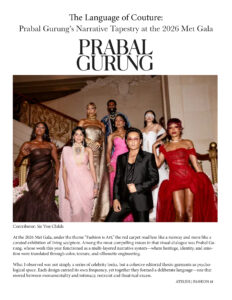
At the 2026 Met Gala, under the theme “Fashion is Art,” the red carpet read less like a runway and more like a curated exhibition of living sculpture. Among the most compelling voices in that visual dialogue was Prabal Gurung, whose work this year functioned as a multi-layered narrative system—where heritage, identity, and emotion were translated through color, texture, and silhouette engineering.
What I observed was not simply a series of celebrity looks, but a cohesive editorial thesis: garments as psychological space. Each design carried its own frequency, yet together they formed a deliberate language—one that moved between monumentality and intimacy, restraint and theatrical excess.
Keke Palmer
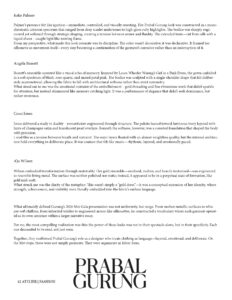
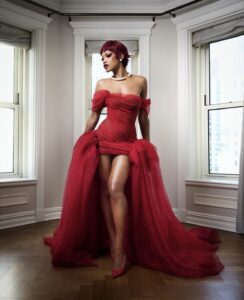
Palmer’s presence felt like ignition—immediate, controlled, and visually arresting. Her Prabal Gurung look was constructed in a monochromatic crimson spectrum that ranged from deep scarlet undertones to high-gloss ruby highlights. The bodice was sharply engineered yet softened through strategic draping, creating a tension between armor and fluidity. The extended train—cut from silk with a liquid sheen—caught light like moving flame.
From my perspective, what made this look resonate was its discipline. The color wasn’t decorative; it was declarative. It framed her silhouette as movement itself—every step becoming a continuation of the garment’s narrative rather than an interruption of it.
Angela Bassett
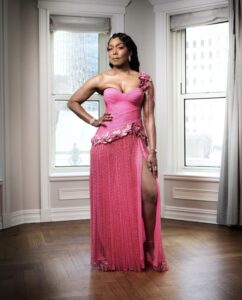
Bassett’s ensemble operated like a visual echo of memory. Inspired by Laura Wheeler Waring’s Girl in a Pink Dress, the gown unfolded in a soft spectrum of blush, rose quartz, and muted petal pink. The bodice was sculpted with a single-shoulder drape that felt deliberately asymmetrical, allowing the fabric to fall with architectural softness rather than strict symmetry.
What stood out to me was the emotional restraint of the embellishment—gold threading and fine rhinestone work that didn’t sparkle for attention, but instead shimmered like memory catching light. It was a performance of elegance that didn’t seek dominance, but rather reverence.
Coco Jones
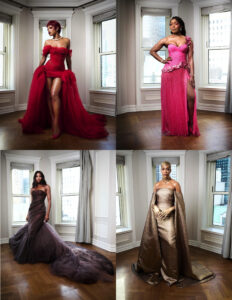
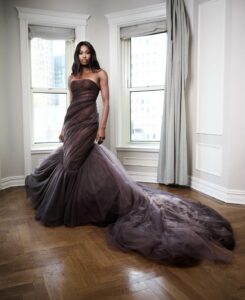
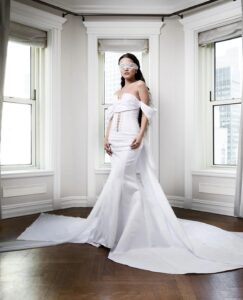
Jones delivered a study in duality—romanticism engineered through structure. The palette leaned toward luminous ivory layered with hints of champagne satin and translucent pearl overlays. Beneath the softness, however, was a corseted foundation that shaped the body with precision.
I read this as a tension between breath and restraint. The outer layers floated with an almost weightless quality, but the internal architecture held everything in deliberate place. It was couture that felt like music—rhythmic, layered, and emotionally paced.
A’ja Wilson
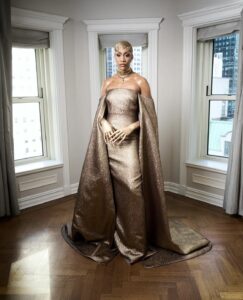
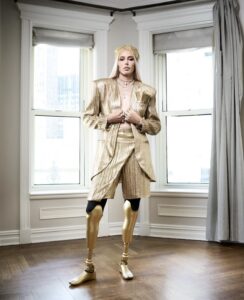
Wilson embodied transformation through materiality. Her gold ensemble—oxidized, molten, and heavily texturized—was engineered to resemble living metal. The surface was neither polished nor static; instead, it appeared to be in a perpetual state of formation, like gold mid-melt.
What struck me was the clarity of the metaphor. This wasn’t simply a “gold dress”—it was a conceptual extension of her identity, where strength, achievement, and visibility were literally embedded into the fabric’s surface language.
What ultimately defined Gurung’s 2026 Met Gala presentation was not uniformity, but range. From molten metallic surfaces to whisper-soft chiffons, from inherited textiles to engineered armor-like silhouettes, he constructed a vocabulary where each garment operated as its own sentence within a larger narrative essay.
For me, the most compelling realization was this: the power of these looks was not in their spectacle alone, but in their specificity. Each one demanded to be read, not just seen.
Together, they reaffirmed Prabal Gurung’s role as a designer who treats clothing as language—layered, emotional, and deliberate. On the Met steps, these were not simply garments. They were arguments in fabric form.

