
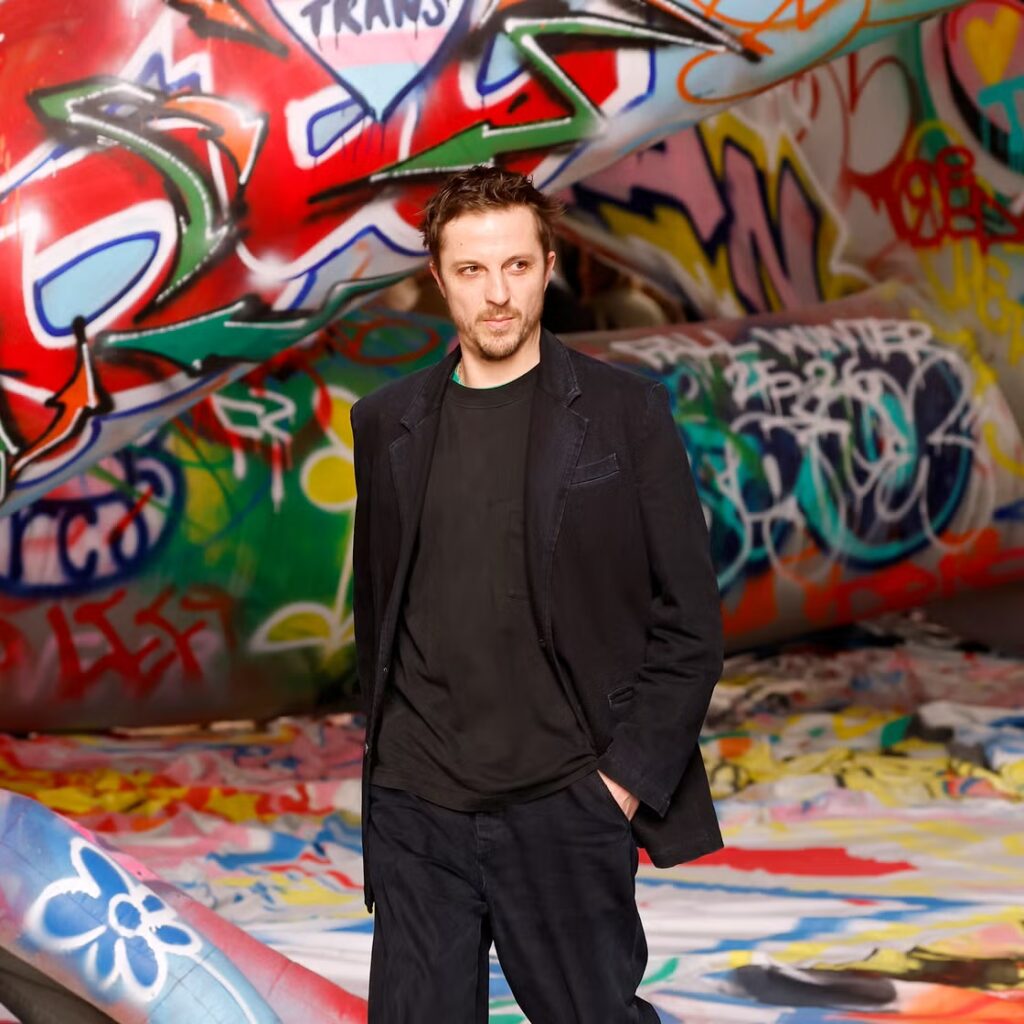
Six years after transforming Diesel from a familiar denim label into one of fashion’s loudest cultural provocateurs, Glenn Martens is preparing his final collection for the Italian brand. His departure is more than another designer exit—it closes one of the clearest case studies in how creative direction can turn heritage into relevance without treating the archive like a museum.
One Final Diesel Show
Glenn Martens is stepping down as Diesel’s creative director after six years, with next week’s Spring/Summer 2027 presentation in Milan set to be his final runway show for the house. Martens, appointed by Diesel founder Renzo Rosso in October 2020, will remain within the OTB group and focus on his role as creative director of Maison Margiela, which he assumed in January 2025.
The distinction matters. This is not Martens abandoning the wider OTB ecosystem. It is the closing of one creative chapter after a tenure that changed how Diesel was perceived—and, according to OTB, helped the brand achieve its best performance in a decade in 2025.
Diesel Before Martens
When Martens arrived, Diesel already possessed something many fashion businesses spend fortunes trying to acquire: global recognition. But familiarity is not the same as cultural authority. The challenge was not to introduce Diesel to the world. It was to make a brand founded in 1978 feel urgent again.
Martens resisted the obvious route. He did not attempt to turn Diesel into a quieter approximation of traditional European luxury. Instead, he amplified what competitors could not easily reproduce: denim expertise, irreverence, sexuality, experimentation, accessibility and an instinct for spectacle.
Making Denim Strange Again
Denim remained the foundation, but under Martens it became less a uniform than a laboratory. Across collections, the material was distorted, coated, distressed, reconstructed and pushed into unlikely silhouettes. Resort 2027 alone continued that approach with denim engineered to mimic leather, hybrid garments and technically manipulated surfaces.
The significance was larger than any single pair of jeans. Martens demonstrated that a heritage code does not have to become a constraint. In the right hands, repetition can become experimentation.



The Runway Became Media
Martens also understood that a runway could function as something more expansive than an industry presentation. Diesel staged shows around monumental inflatable figures, hundreds of thousands of condom boxes, a rain-soaked rave, denim waste and other installations designed to travel far beyond the physical audience.
That audience itself became part of the strategy. Thousands of students and members of the public were invited into a system fashion traditionally reserves for editors, buyers, celebrities and clients. Diesel’s accessibility was not treated as something to disguise on the road toward greater fashion credibility. It became part of the spectacle.
Why the Revival Worked
The most instructive part of the Martens era may be that Diesel’s revival did not depend on pretending the company was something else. Fashion’s heritage conversation often defaults to preservation: protect the codes, polish the archive, lower the volume. Martens offered another model.
He made Diesel louder.
That approach gave the house a recognizable visual and cultural language at a moment when many established labels were searching for relevance through creative-director turnover. The result suggests a useful principle for heritage brands: modernization can come from identifying the qualities competitors cannot credibly imitate and pushing those qualities further.
Margiela Changes the Equation
Martens’ departure also reflects the growing importance of his responsibilities at Maison Margiela. He took over the Paris house following John Galliano’s departure and will now concentrate his energies there.
The move creates an intriguing next chapter, but it should not be mistaken for evidence of what Martens will do creatively at Margiela beyond what has been announced. Diesel and Margiela possess distinct histories, audiences and design languages. The more revealing question will be how a designer celebrated for reinvention adjusts when his full attention shifts from one influential house to another.
The Succession Problem
Diesel now inherits the difficult part of a successful revival.
When a creative director becomes deeply associated with a brand’s renewed cultural relevance, succession is not simply a hiring decision. The next leader must inherit momentum without reducing the house to an imitation of the departing designer.
Diesel has said its future creative direction will be announced in due course. Until then, speculation about a successor is exactly that: speculation.
The Experiment Worked
The most durable creative-director tenures leave behind more than recognizable collections. They alter what a brand believes it is capable of doing.
Martens’ real legacy at Diesel will not be determined by whether the house continues to look like the Diesel he created. It will be measured by whether Diesel retains the confidence to remain unpredictable after he is gone.
That may be the most useful lesson of the entire experiment. Heritage does not always need to be protected from change. Sometimes the most respectful thing a designer can do with an archive is give it permission to misbehave again.

